
Roadscape is past the mockup stage.
This page separates the evidence from the sales page: real traffic video loaded into the editor, screenshots from the working UI, a saved segment/report smoke test, and corridor-simulation sweep results. Status: about 76% demo-ready. Official-grade still needs permissioned field footage, hand counts, protocol, and PE review.
Real TW3 validation footage encoded as WebM so the browser editor can load it reliably.
What is verified
These are working pieces from the local build, not future promises. They are still screening-grade until validated with field footage and hand counts.
Traffic Editor loads real video
The TW3 clip is now in the sample library and loads through the same browser path a user would use.
Segments can be saved
Counter name, corridor, direction labels, time window, confidence, count mode, and line setup are saved for repeat runs.
Reports carry evidence
The generated HTML report includes counter segments, settings, screenshots, export data, assumptions, and caveats.
Traffic Editor screens
The working UI is moving toward a full desktop editor feel: media in, segment setup, scan, validate, export.
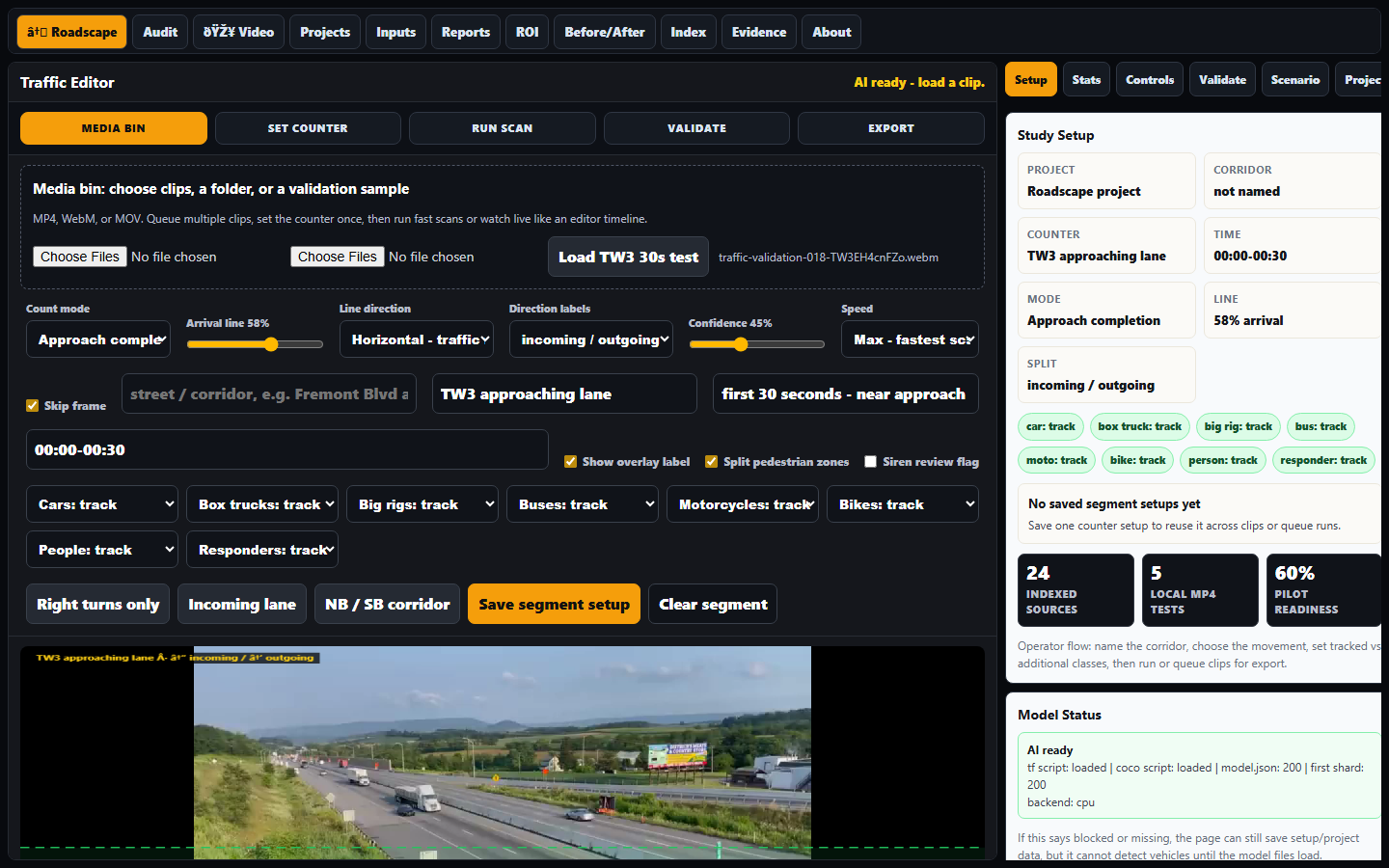
TW3 clip loaded in the editor with the real video frame visible.
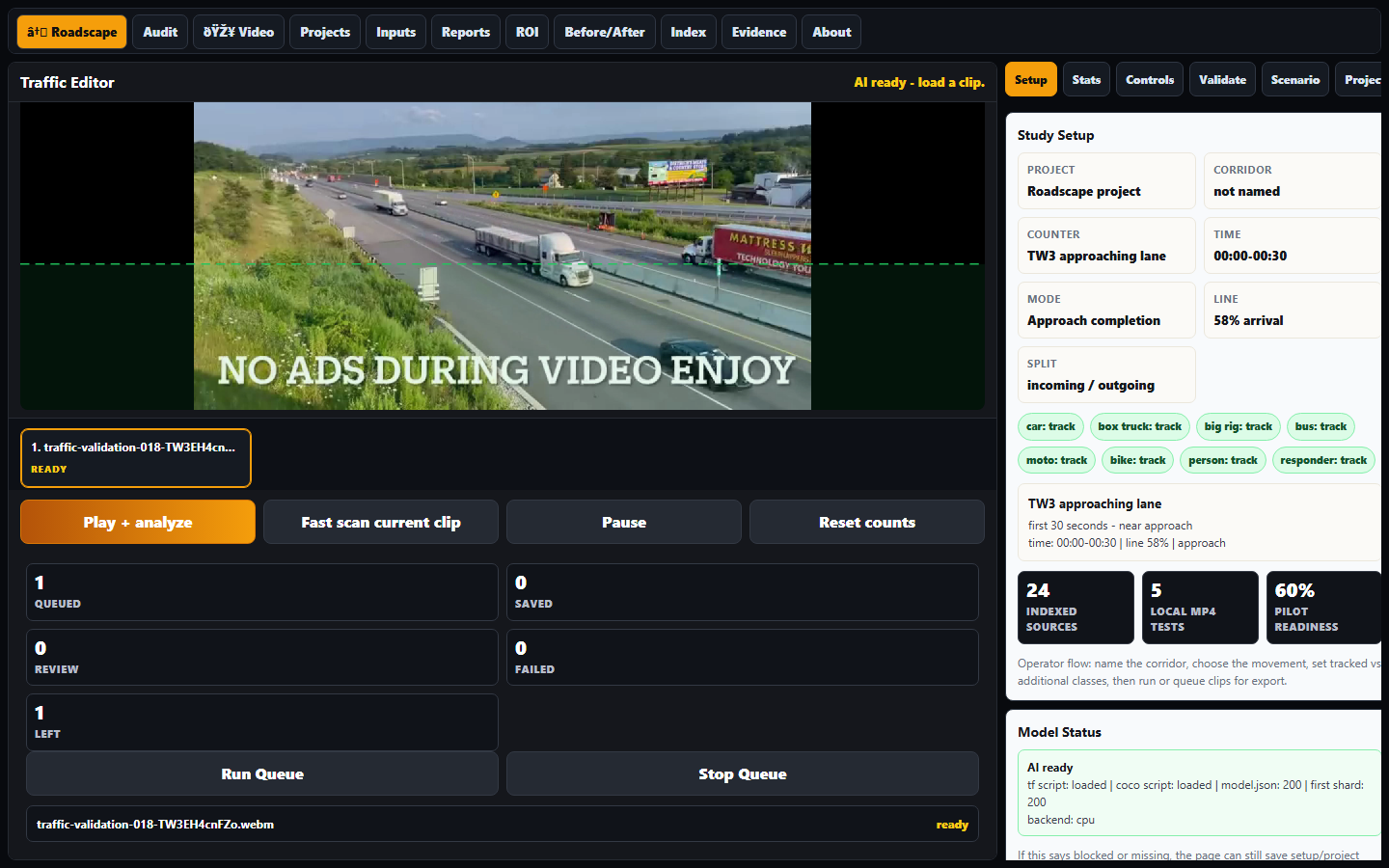
Fast-scan pass running through the UI, preserving the visible count and setup context.
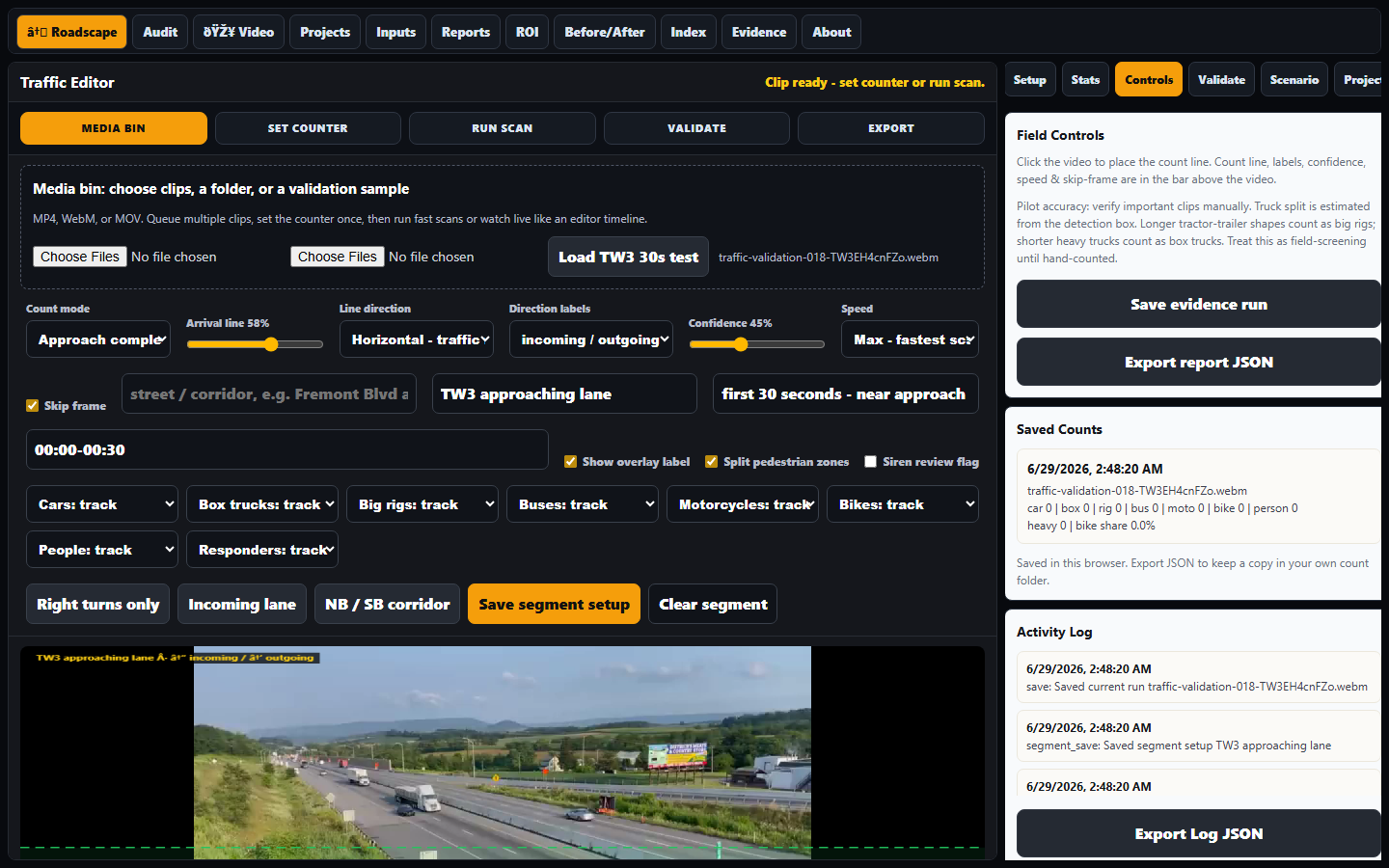
Report smoke test: counter segment data appears in the exported report.
Live software run: video analysis visible as an active Roadscape workflow, not a stale queue screenshot.
Running proof wall
Four moving clips are shown together: real traffic footage, the live software run, and two modern corridor-simulation clips. The stills below stay as audit screenshots.
TW3 validation footage: trucks, wide-view movement, and direction stress.
Roadscape running through the local video-analysis workflow.
Modern corridor sim: green-wave timing, turn-pocket geometry, EV/Tesla mix, and live queue behavior.
Bad-coordination corridor sim: platoons hit the red and queue pressure builds.
Editor loaded with real traffic footage and the current workflow view.
Fast-scan proof with modern editor controls and visible count context.
Report export proof: segment data flows into the evidence export.
Corridor-sim sweep
The sim is for planning explanation, not final engineering. It shows how signal coordination, right-turn demand, narrowed capacity, and platoons can change delay and queue behavior.
| Scenario | Before delay | After delay | Residual queue | Green flow | Read |
|---|---|---|---|---|---|
| Bad coordination, 1600/hr | 5s | 6s | 17 -> 16 | 17 -> 16 | Delay shows narrowed-capacity penalty |
| Green wave, 1600/hr | 0s | 7s | 0 -> 6 | 16 -> 19 | Coordination helps, geometry still matters |
| Bad coordination, high right-turn | 4s | 5s | 17 -> 16 | 17 -> 16 | Delay remains the clean pitch metric |
| Bad coordination, 1100/hr | 3s | 4s | 12 -> 12 | 12 -> 12 | Lower volume still shows a small penalty |
Simulator video: bad coordination, 1600/hr, right-turn pressure, freight mix.
Simulator video: green-wave timing with turn-pocket geometry and EV/Tesla mix.
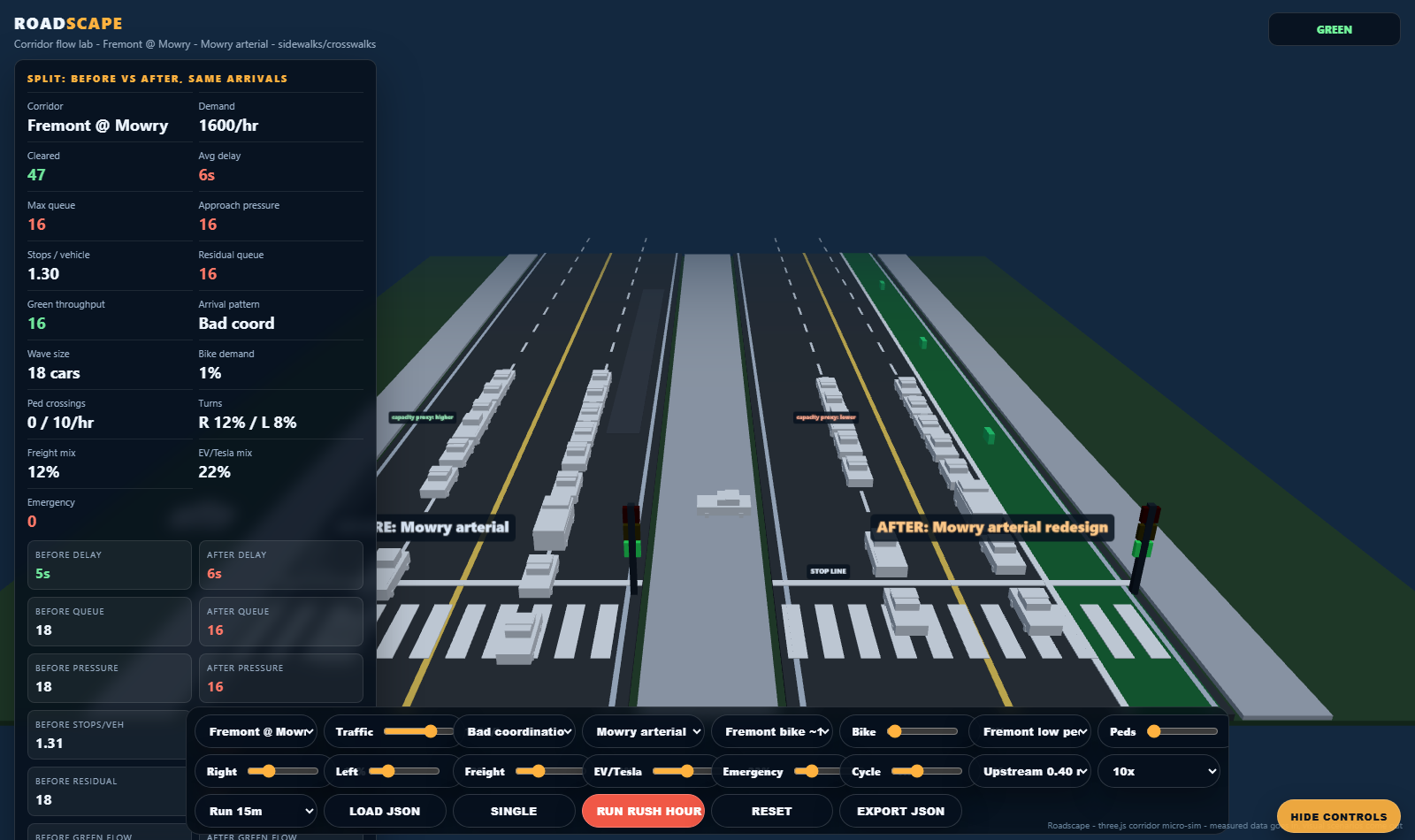
Still screenshot stays in: bad coordination scenario with platoons stacking delay.
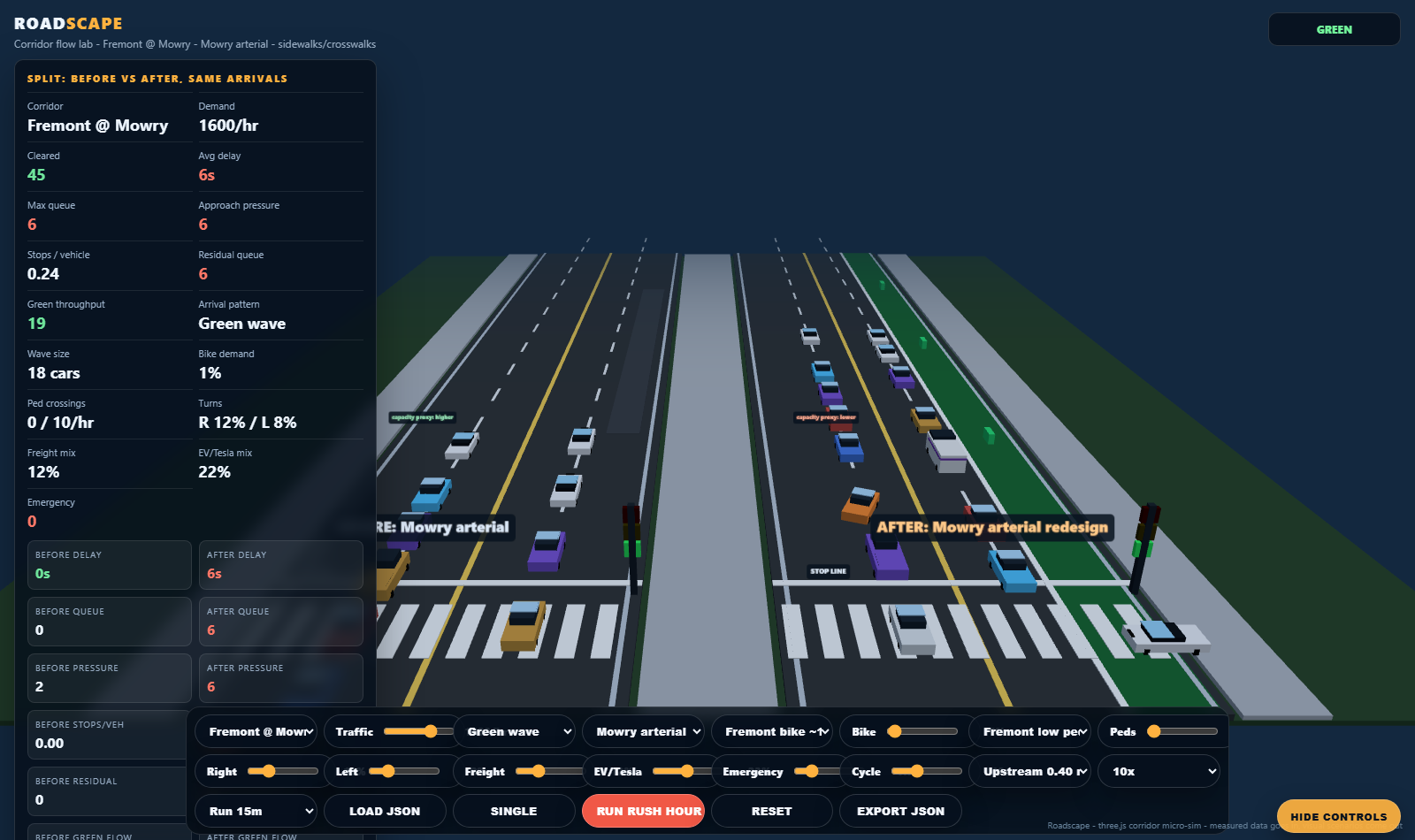
Still screenshot stays in: green-wave scenario for quick report reference.
Fremont-style sim run: protected-bike geometry, platoon arrivals, heavier freight, and a higher EV/Tesla mix shown as a moving planning layer.
What this means now
Roadscape is demo-ready enough to show as a working product direction: editor, real clip, saved setup, export, simulation, and report language. It is not official-grade yet. The next serious proof is your own Fremont footage, a hand-count baseline, and an engineer-reviewed method.